PENNINGTON BLADE BENDER for Short Track Blade Bending
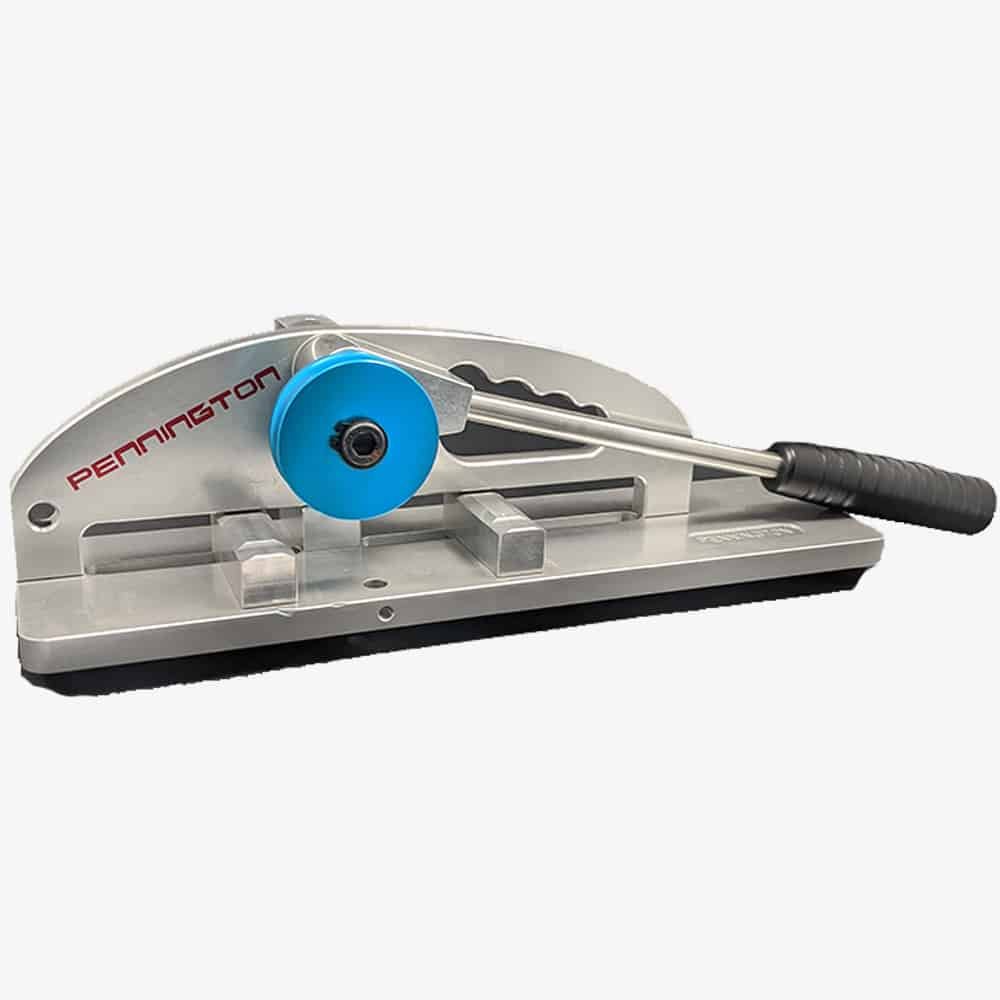
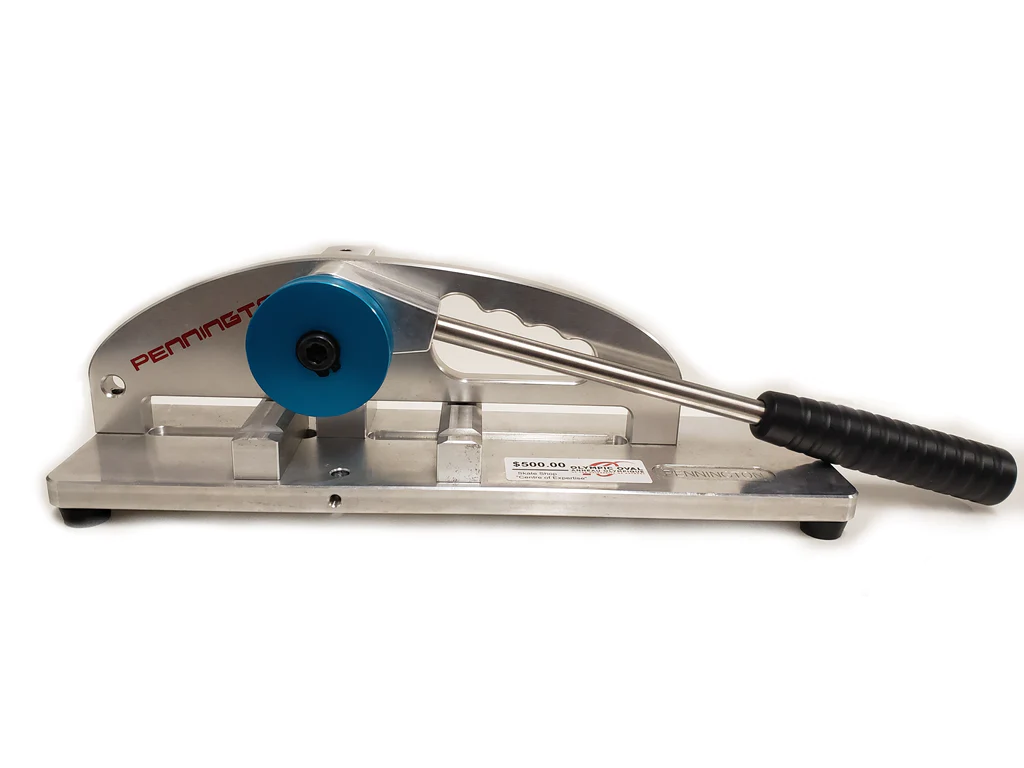
Pennington Blade Bender now with a larger pulley. besides which it allows you to bend all types of blades.
This easy-to-use bender offers a longer leverage handle for easier operations. In addition it also allows for the installation of a gauge for micrometric adjustments.
Furthermore all of the parts are made of high grade aluminum.
Now with larger bending wheel featuring infinitely variable blade supports and allows you to fit an optional dial gauge for micro adjustments.
Leverage to the pressure wheel is through a hardened steel axle which means longer wearing (no flex no bend).
Major body parts in structural grade alloy.
New Model Bender has high leverage for ease of operation now with larger bending wheel featuring infinitely variable blade supports and allows you to fit an optional dial gauge for micro adjustments. Leverage to the pressure wheel is through a hardened steel axle which means longer wearing (no flex no bend). Major body parts in structural grade alloy.
Precision Blade Bender (New Model)
The Precision Blade Bender (New Model) is a simple, easy-to-use tool designed for accurate and consistent blade bending. Built with a high-leverage mechanism, it delivers smooth operation with minimal effort, making it ideal for both professional and workshop use.
Now upgraded with a larger bending wheel, this PENNINGTON Short track bender provides improved control and precision. The infinitely variable blade supports allow for flexible positioning, ensuring compatibility with a wide range of blade sizes and profiles. An optional accessory fitting is also available to further expand its functionality.
PENNINGTON BLADE BENDER Key Features:
-
High-leverage design for effortless operation
-
Larger bending wheel for enhanced accuracy
-
Infinitely adjustable blade supports
-
Compatible with optional add-on accessories
-
Durable, workshop-ready construction
Aluminum Alloy
Aluminum alloy is a material made by combining aluminum with other elements—such as magnesium, silicon, copper, or zinc—to improve its strength, durability, corrosion resistance, and other mechanical properties.
Pure aluminum is lightweight and corrosion-resistant but relatively soft. By adding alloying elements, manufacturers can significantly enhance its performance for structural, industrial, and consumer applications.
PENNINGTON BLADE BENDER Key Characteristics
-
Lightweight – About one-third the weight of steel
-
High strength-to-weight ratio – Strong yet easy to handle
-
Corrosion resistant – Naturally forms a protective oxide layer
-
Good conductivity – Conducts heat and electricity efficiently
-
Formable and machinable – Easy to shape, bend, and machine
-
Recyclable – 100% recyclable without loss of properties
Common Alloying Elements & Their Effects
-
Magnesium – Increases strength and corrosion resistance
-
Silicon – Improves casting properties
-
Copper – Adds strength but may reduce corrosion resistance
-
Zinc – Significantly increases strength
-
Manganese – Enhances durability and workability
Main Alloy Series (Wrought Alloys)
-
1000 Series – Nearly pure aluminum (excellent corrosion resistance)
-
2000 Series – Aluminum-copper alloys (high strength)
-
3000 Series – Aluminum-manganese alloys (good workability)
-
5000 Series – Aluminum-magnesium alloys (marine applications)
-
6000 Series – Aluminum-magnesium-silicon alloys (structural use)
-
7000 Series – Aluminum-zinc alloys (very high strength)
Typical Applications
Aluminum alloys are widely used where strength, low weight, and corrosion resistance are critical.
See other benders here
Know more about Pennington here
In Addition a video on Bending and checking blades rocker.
Lastly you can see all our Benders and Gauges here.



















Reviews
There are no reviews yet.